
Aplicación de mezclas de herbicidas pre-emergentes como tecnología clave para un manejo eficiente de malezas en mandioca (Manihot esculenta Crantz)
DOI:
https://doi.org/10.18004/investig.agrar.2026.e2801867Palabras clave:
Manihot esculenta, herbicidas preemergentes, control de maleza, eficacia agronómica, mezclas de herbicidasResumen
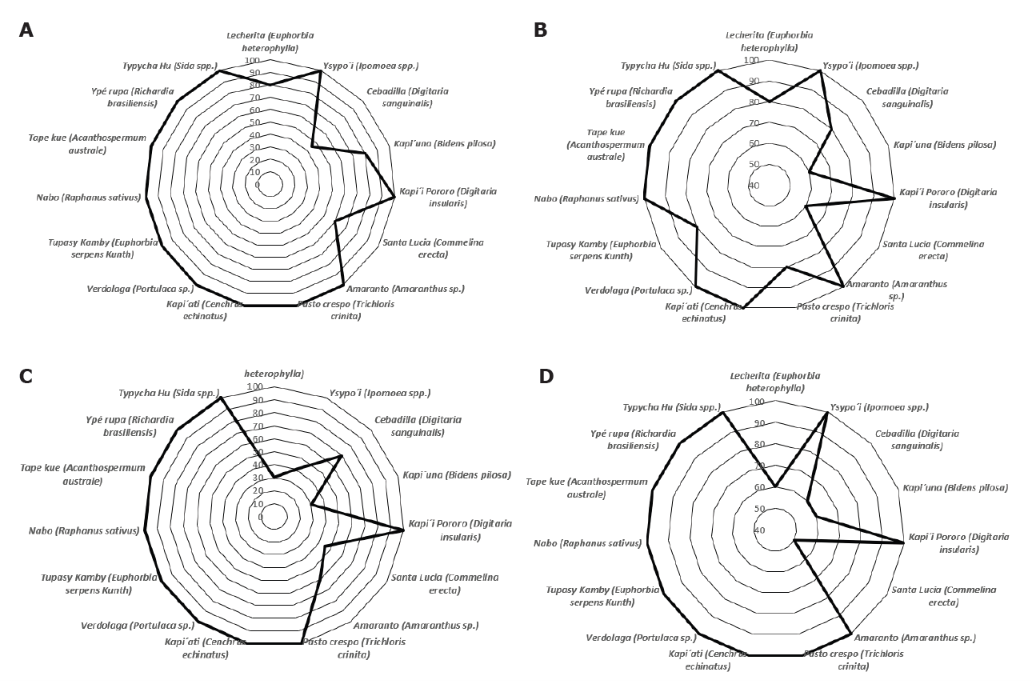
La mandioca (Manihot esculenta Crantz) es un cultivo de gran importancia para la seguridad alimentaria nacional y representa una fuente fundamental de materia prima para las industrias almidoneras contribuyendo al ingreso económico del Paraguay. Posee amplia adaptación a diferentes condiciones edafoclimáticas, siendo estratégico para el desarrollo agroindustrial. Este trabajo se realizó con el objetivo de evaluar la eficacia de diferentes principios activos y sus combinaciones aplicados en preemergencia para el control de malezas en mandioca. Se implementó un diseño experimental de bloques completos al azar con ocho tratamientos y tres repeticiones, en dos localidades de la Región Oriental de Paraguay. Los tratamientos fueron: Clomazone 50% (2,5 l ha-1) + Sulfentrazone 50% (0,5 l ha-1); Flumioxazina 48% (150 g ha-1) + Piroxasulfona 85%(200 g ha-1); Metalaclor 96% (2 l ha-1) + Flumioxazina 48% (150 g ha-1); Flumioxazina 48% (150 g ha-1) + Clamozone 50% (2,5 l ha-1); Flumioxazina 48% (150 g ha-1); Metalaclor (2 l ha-1); Piroxasulfona 85% (200 g ha-1) y un Testigo (Sin aplicación). La evaluación del control se realizó mediante la escala visual de ALAM (1974) a los 21 días después de la aplicación (DDA) y como variable principal para este estudio se consideró el porcentaje de control. Los datos fueron sometidos a ANOVA y prueba de Tukey (p ≤ 0,05). Los tratamientos con Clomazone + Sulfentrazone (99,53%), Flumioxazina + Piroxasulfona (99,1%) y Metalaclor + Flumioxazina (98,43%) mostraron control óptimo (≥91%), sin diferencias significativas entre ellos. La Flumioxazina sola y el Piroxasulfona solo presentaron control "Muy bueno" (89,33% y 88,67%, respectivamente), mientras que Metalaclor sola obtuvo control "Bueno" (78,33%). Las combinaciones de herbicidas con diferentes mecanismos de acción resultaron más efectivas que las aplicaciones individuales, destacándose las mezclas que incluyen Flumioxazina y Clomazone.Descargas
Citas
Albrecht, L., Albrecht, A., Moreira Silva, A. F. M., Buss Tupich, F. L. B., Alves Ferrari, D. H. A., Larini, W. F., Benincá, L. H. G., & de Oliveira, V. H. (2025). Broad spectrum effectiveness of pyroxasulfone + flumioxazin for weed control in pre-emergence of soybean. Revista Agrogeoambiental, 17, e20251962. https://doi.org/10.18406/2316-1817v17nunico20251962
Amelework, A. B., & Bairu, M. W. (2022). Advances in Genetic Analysis and Breeding of Cassava (Manihot esculenta Crantz): A Review, Plants 11(12), 1617. https://doi.org/10.3390/plants11121617
Arthur, G. D., Naidoo K. K., & Coopoosamy, R. M. (2012). Bidens pilosa L.: agricultural and pharmaceutical importance. Journal of Medicinal Plants Research, 6(17), 3282-3287. https://www.researchgate.net/publication/267725734_Bidens_pilosa_L_Agricultural_and_pharmaceutical_importance
Brighenti, A. M. (2019). Bidens pilosa L. (Asteraceae) control in sunflower with residual herbicides. Comunicata Scientiae, 10(2), 293–300. https://doi.org/10.14295/cs.v10i2.2942
Carvalho, D. D. de, Ferrari Schedenffeldt, B. F., Pereira, G. R., & Monquero, P. A.(2025). Effectiveness of flumioxazin alone and in combination with other herbicides for controlling different weed emergence patterns and species. Journal of Environmental Science and Health, Part B. 60(4), 161 – 169. https://doi.org/10.1080/03601234.2025.2475651
Castro, M. A., Lima, S. F., Tomquelski, G. V., Andrade, M. G. O., & Martins, J. (2021). Crop management and its effects on weed occurrences. Bioscience Journal, 37, e37012. https://doi.org/10.14393/BJ-v37n0a2021-48271
Castro, R. A. de, Castro, S. G. Q. de, Castro, S. A. Q. de, Piassa, A., Soares, G. O. N., Tropaldi, L., & Christoffoleti, P. J. (2024). Optimizing herbicide selection for pre-emergence control of itchgrass and cypressvine morningglory in sugarcane. Journal of Environmental Science and Health, Part B, 59(6), 350–360. https://doi.org/10.1080/03601234.2024.2352321
Clement, C. R., Cristo-Araújo, M. D., D'Eeckenbrugge, G. C., Alves-Pereira, A., & Picanço-Rodrigues, D. (2010) Origen y domesticación de cultivos nativos de la Amazonía. Diversidad 2(1),72–106. https://doi.org/10.3390/d2010072
Costa, N. V., Ritter, L., Peres, E. J. L., Silva, P.V., & Vasconcelos, E. S. (2013). Weed interference periods in the ‘fécula branca’ cassava. Planta Daninha, 31(3), 533-542. https://doi.org/10.1590/S0100-83582013000300005
da Silva, M. M., Almeida, E. I. B., Sousa, A. M., Ponte, I. S., Ribeiro, B. da S. B., Sousa, D. L. de, Sousa, A. C. de, Sousa, W. da S., Oliveira, L. B. T. de, & Souza, J. B. C. (2024). Pre-emergence herbicides effects in no-till soybean system with Panicum maximum 'BRS Tamani'. Australian Journal of Crop Science, 18(1), 21–28. https://doi.org/10.21475/ajcs.24.18.01.p4018
Duarte, A. P., Silva, A. C., & Deuber, R. (2007). Plantas infestantes em lavouras de milho safrinha, sob diferentes manejos, no Médio Paranapanema. Planta Daninha, 25(2), 285–291. https://doi.org/10.1590/S0100-83582007000200007
Ekeleme, F., Dixon, A., Atser, G., Hauser, S., Chikoye, D., Olorunmaiye, P., Olojede, A., Korie, S., y Weller, S. (2020). Screening preemergence herbicides for weed control in cassava. Weed Technol., 34(5), 735–747. https://doi.org/10.1017/wet.2020.26
Ekeleme, F., Dixon, A., Atser, G., Hauser, S., Chikoye, D., Korie, S., Olojede, A., Agada, M., & Olorunmaiye, P. M. (2021). Increasing cassava root yield on farmers' fields in Nigeria through appropriate weed management. Crop Protection, 150, 105810. https://doi.org/10.1016/j.cropro.2021.105810
Finnis, E., Benítez, C., Candia Romero, E. F., & Aparicio Meza, M. J. (2013). Agricultural and dietary meanings of mandioca in rural Paraguay. Food and Foodways, 21(3), 163–185. https://doi.org/10.1080/07409710.2013.792197
Fontes, J. R. A., Oliveira, I. J., & Morais, R. R. (2021). Selectivity and efficiency of herbicides in cassava on the floodplain of the Solimões river. Revista Agro@mbiente On-line, 15, 1–15. https://doi.org/10.18227/1982-8470ragro.v15i0.6393
Gazola, T., Gomes, D. M., Belapart, D., Dias, M. F., Carbonari, C. A., & Velini, E. D. (2021). Selectivity and residual weed control of pre-emergent herbicides in soybean crop. Revista Ceres, 68(3), 219-229. https://doi.org/10.1590/0034-737X202168030008
Green, J. M., & Owen, M. D. K. (2011). Herbicide-resistant crops: Utilities and limitations for herbicide-resistant weed management. Journal of Agricultural and Food Chemistry, 59(11), 5819–5829. https://doi.org/10.1021/jf101286h
Hejazirad, S. P., de Abreu, C. M., Carneiro, G. H. F., Gomes, C. R., Spinola Filho, P. R. de C., da Costa, M. R., & Santos, J. B. dos. (2024). The impact of metolachlor applications and phytoremediation processes on soil microorganisms: Insights from functional metagenomics analysis. Journal of Xenobiotics, 14(3), 970–988. https://doi.org/10.3390/jox14030054
Jhala, A. J., Singh, M., Shergill, L., Singh, R., Jugulam, M., Riechers, D. E., Ganie, Z. A., Selby, T. P., Werle, R., & Norsworthy, J. K. (2024). Very long chain fatty acid–inhibiting herbicides: Current uses, site of action, herbicide-resistant weeds, and future. Weed Technology, 38, e1. https://doi.org/10.1017/wet.2023.90
Kato-Noguchi, H., & Kurniadie, D. (2024). The invasive mechanisms of the noxious alien plant species. Bidens pilosa. Plants, 13(3), 356. https://doi.org/10.3390/plants13030356
Kousta, A., Katsis, C., Tsekoura, A., & Chachalis, D. (2024). Effectiveness and selectivity of pre- and post-emergence herbicides for weed control in grain legumes. Plants, 13(2), 211. https://doi.org/10.3390/plants13020211
Lópes, A. P. M., Soares, M. R. C., Chidichima, L. P. S., & Dias-Arieira, C. R. (2020). Weed hosts of Meloidogyne spp. and the effect of aqueous weed extracts on egg hatching. Weed Research, 60(2), 142–149. https://doi.org/10.1111/wre.12399
Machado Filho, G. C., Mota, M. A., Montelo, A. B., Farias, D. I. O. A. de, Nascimento, I. R. do, & Santos, M. M. dos. (2018). Herbicide selectivity to cassava crop in post-emergence application. Communications in Plant Sciences, 8, 112–115. https://thecpsjournal.wordpress.com/wp-content/uploads/2018/11/cps2018015.pdf
Miléo, L. J., Silva, J. F., Albertino, S. M. F., Leite, B. N., Menezes, D. S., & Santos, A. F. (2016). Phytosociology of weeds in cultivation of two varieties of cassava. Planta Daninha, 34(2), 267–276. https://doi.org/10.1590/S0100-83582016340200008
Muke, A., Nabahungu, L., Kinché, K., Vanlauwe, B., & Boeckx, P. (2024). Weeding force saving to improve profitability of cassava-legumes cropping systems in eastern Democratic Republic of the Congo. Crop Protection, 187, e106958. https://doi.org/10.1016/j.cropro.2024.106958
Munaro, F. C., Silva, P. V. da, Borges, R. P. P. N., Medeiros, E. S. de, Schedenffeldt, B. F., Monquero, P. A., Ortiz, M. F., Westra, E. P., Salmazo, P. A. V., Mauad, M., & Dias, R. de C. (2025). Combination of pre-emergence herbicides for weed control in soybean. International Journal of Agriculture and Biology, 34, e340211. https://doi.org/10.17957/IJAB/15.2359
Ola, O. T., Ekhator, F., Opabode, J. T., Akinyemiju, O. A., & Ogedengbe, O. O. (2021). Evaluation of two contrasting cassava canopy structures on weed flora composition in a rainforest zone of Nigeria. Journal of Natural Sciences Research, 12(12), 45–52. https://doi.org/10.7176/JNSR/12-12-05
Ovejero, R., Soares, D. J., Oliveira, W. S., Fonseca, L. B., Berger, G. U., Soteres, J. K., & Christoffoleti, P. J. (2013). Residual herbicides in weed management for glyphosate-resistant soybean in Brazil. Planta Daninha, 31(4), 947–959. https://doi.org/10.1590/S0100-83582013000400021
Parra Rapado, L., Kölpin, F. U. G., Zeyer, S., Anders, U., Priccard, L., Porri, A., & Asher, S. (2025). Complementary activity of trifludimoxazin and saflufenacil when used in combination for postemergence and residual weed control. Weed Science, 73, e14. https://doi.org/10.1017/wsc.2024.92
Pinto Ruiz, G. A., Medina, R. D., Tarragó, J., & Burgos, Á. (2024). Selectivity of pre-emergent herbicides in cassava (Manihot esculenta Crantz) and its relationship with the stem cutting planting system. Crop Protection, 187, e106985. https://doi.org/10.1016/j.cropro.2024.106985
Quee, D. D., Sarkodie-Addo, J., Duku, S., Samura, A., Conteh, A., Bebeley, J., & Sesay, J. V. (2016). Economic evaluation of weed control and herbicide residues on cassava (Manihot esculenta Crantz) in Ghana. The Journal of Agricultural Science, 8(7), 47–53. https://doi.org/10.5539/jas.v8n7p47
Rojas-Sandoval, J. (2020). Bidens pilosa (blackjack). CABI Compendium. https://doi.org/10.1079/isc.9148.20203483381
Salomão, H. M., Trezzi, M., Viecelli, M., Pagnoncelli Junior, F. de B., Patel, F., Damo, L., & Frizzon, G. (2021). Weed management with pre-emergent herbicides in soybean crops. Communications in Plant Sciences, 11, 60–66. https://doi.org/10.26814/cps2021008
Santiago, A. D., Cavalcante, M. H. B., Braz, G. B. P., & Procópio, S. O. (2018). Efficacy and selectivity of herbicides applied in cassava pre-emergence. Revista Caatinga, 31(3), 640–650. https://doi.org/10.1590/1983-21252018v31n312rc
Santos, J., & Cury, J. P. (2011). Picão-preto: Uma planta daninha especial em solos tropicais. Planta Daninha, 29, 1159–1171. https://doi.org/10.1590/S0100-83582011000500024
Silva, T. S., Arneson, N. J., DeWerff, R. P., Smith, D. H., Silva, D. V., & Werle, R. (2023). Preemergence herbicide premixes reduce the risk of soil residual weed control failure in corn. Weed Technology, 37(4), 410–421. https://doi.org/10.1017/wet.2023.45
Silva, A. G. C. da, Monteiro, A. L., Souza, M. de F., Bandeira, J. N., Coêlho, E. dos S., Diniz, B. P. S., Barros Júnior, A. P., & Silva, D. V. (2025). Selectivity and efficacy of herbicides applied in pre-emergence in cassava crop. IEEE Access, 13, 7614–7622. https://doi.org/10.1109/ACCESS.2025.3526699
Silva, M. de S. da, Furtado, J. A. L., Castro, J. Q., Santos, I. L. dos, Almeida, E. I. B., Oliveira, L. B. T. de, Sousa, W. da S., & Araújo, R. C. de A. (2021). Weed control and selectivity of different pre-emergence active ingredients in a soybean crop. Agronomía Colombiana, 39(3), 392–404. https://doi.org/10.15446/agron.colomb.v39n3.96334
Soltani, N., Brown, L., & Sikkema, P. (2019). Weed control in corn and soybean with Group 15 (VLCFA inhibitor) herbicides applied preemergence. International Journal of Agronomy, 2019, 8159671. https://doi.org/10.1155/2019/8159671
Takano, H. K., Ovejero, R. F. L., Belchior, G. G., Maymone, G. P. L., & Dayan, F. E. (2021). ACCase-inhibiting herbicides: Mechanism of action, resistance evolution and stewardship. Scientia Agricola, 78(1), e20190102. https://doi.org/10.1590/1678-992X-2019-0102
Tironi, L. F., Zanon, A. J., Alves, A. F., Freitas, C. P. O., Santos, A. T. L., Cardoso, P. S., Tonel, G. P., Rodrigues, L. B., Tagliapietra, B. L., Silva, M. N., & Streck, N. A. (2019). Eco-fisiologia da mandioca visando altas produtividades. Editora GR.
Weisskoff, R. (1992). The Paraguayan agro-export model of development. World Development, 20(10), 1531–1540. https://doi.org/10.1016/0305-750X(92)90072-4
Yamaji, Y., Honda, H., Hanai, R., & Inoue, J. (2016). Soil and environmental factors affecting the efficacy of pyroxasulfone for weed control. Journal of Pesticide Science, 41(1), 1–5. https://doi.org/10.1584/jpestics.D15-047
Zebalho, C. S., Pilecco, I. B., Streck, N. A., Cardoso, P. de S., Freitas, C. P. de O. de, Vieira, E. A., Soares, M. F., Tagliapietra, B. L., Ferigolo, A. A., Swarowsky, A., Follmann, D. N. de, Souza, J. V. S. de, & Zanon, A. J. (2025). Assessing management factors limiting yield and starch content of cassava in the western Brazilian Cerrado. Agronomy Journal, 117, e21722. https://doi.org/10.1002/agj2.21722
Descargas
Archivos adicionales
Publicado
Cómo citar
Número
Sección
Licencia
Derechos de autor 2026 Amalio Ramón Mendoza González, Cosme Giménez Pedroso, Alberto Benítez, Elias Achucarro, Francisco Barboza, Francisco Barboza

Esta obra está bajo una licencia internacional Creative Commons Atribución 4.0.
Todo el contenido de esta revista, está bajo Licencia de Atribución Creative Commons.






 Todo el contenido de esta revista, está bajo