
Effect of fertilizer doses and sources on the yield and profitability of the cassava cultivar INIAP P-652 "La Rendidora"
DOI:
https://doi.org/10.18004/investig.agrar.2026.e2801882Keywords:
Manihot esculenta Crantz, Economic benefit, Fertilization, ProductivityAbstract
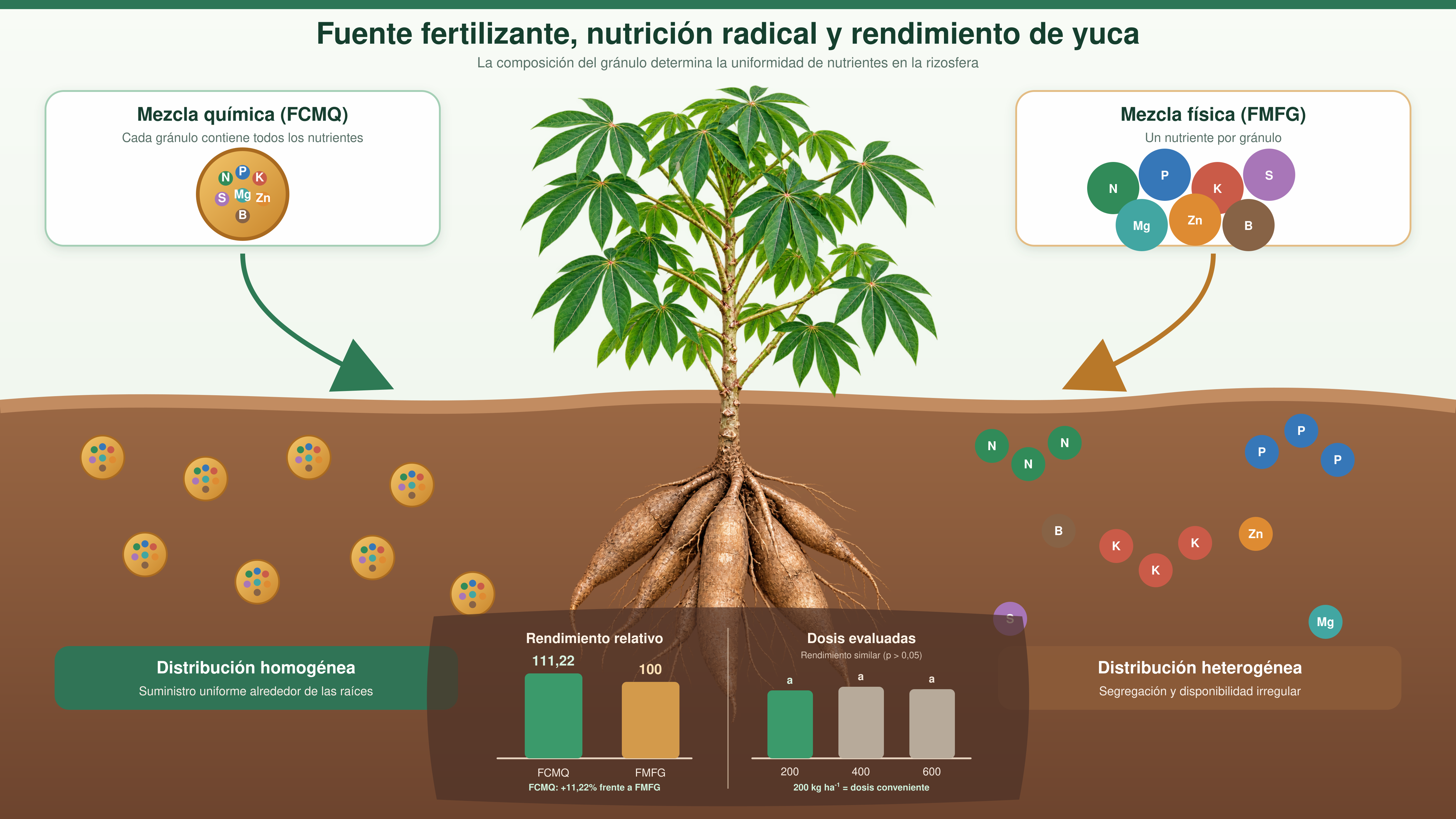
Fertilization is fundamental for efficient root formation and high yield in cassava. The objective of this study was to evaluate the effect of fertilizer doses and sources on the yield and profitability of the cassava cultivar INIAP P-652 "La Rendidora" in Ecuador. Factorial treatments of two fertilizer sources (chemically blended compound fertilizer – CBCF and bulk physically blended fertilizer – BPBF) and three fertilization doses (200, 400, and 600 kg ha⁻¹), plus a control treatment, were evaluated using a randomized complete block design in an A × B + N arrangement. The main variables recorded were root yield (RY), agronomic efficiency of fertilization (AEF), and economic profitability (EP). The results showed that RY was significantly affected (p < 0.05) by the fertilization treatments compared with the control. The CBCF produced the highest RY, with an average increase of 11.22 and 42.95% over the BPBF and the control treatment, respectively. No significant differences (p > 0.05) were detected among doses for RY; therefore, 200 kg ha⁻¹ may be the most convenient dose. The AEF was significantly higher (p < 0.05) with CBCF than with BPBF. The 200 kg ha⁻¹ dose achieved an AEF significantly higher (p < 0.05) than the 400 and 600 kg ha⁻¹ doses. Finally, fertilization with CBCF at a dose of 200 kg ha⁻¹ was the most economically viable alternative, with an average EP of 1.41 dollars per dollar invested and an average net economic benefit of 2,651.5 USD ha⁻¹.Downloads
References
Ayvar-Serna, S., Díaz-Nájera, J. F., Vargas-Hernández, M., Mena-Bahena, A., Tejeda-Reyes, M. A., y Cuevas-Apresa, Z. (2020). Rentabilidad de sistemas de producción de grano y forraje de híbridos de maíz, con fertilización biológica y química en trópico seco. Terra Latinoamericana, 38(1), 9–16. https://doi.org/10.28940/terra.v38i1.507
Adiele, J., Schut, T., van den Beuken, M., Ezui, K., Pypers, P., Ano, O., Egesi, N., & Giller, E. (2020). Towards closing cassava yield gap in West Africa: Agronomic efficiency and storage root yield responses to NPK fertilizers. Field Crops Research, 253, 107820. https://doi.org/10.1016/j.fcr.2020.107820
Atalo, G., Rollon, C., & Jabagat, D. (2025). Impact of nutrient management strategies on cassava performance, nutrient uptake, and economic returns in Agusan del Sur, Philippines. Ceylon Journal of Science, 54(2), 515–525. https://doi.org/10.4038/cjs.v54i2.8550
Borku, W., Tora, T. T., & Masha, M. (2025). Cassava in focus: A comprehensive literature review, its production, processing landscape, and multi-dimensional benefits to society. Food Chemistry Advances, 7, 100945. https://doi.org/10.1016/j.focha.2025.100945
Byju, G., & Haripriya-Anand, M. (2009). Differential response of short- and long-duration cassava cultivars to applied mineral nitrogen. Journal of Plant Nutrition and Soil Science, 172(4), 572–576. https://doi.org/10.1002/jpln.200800044
Castro-Landín, A. L., Navarro-Salto, G. E., Pardo-Reyes, P. S., y Gras-Rodríguez, R. (2025). La yuca (Manihot esculenta Crantz): revisión del uso de biofertilizantes su impacto en la agricultura sostenible en Ecuador. Revista Científica ‘‘INGENIAR”: Ingeniería, Tecnología e Investigación, 8(15), 225-239. https://journalingeniar.org/index.php/ingeniar/article/view/290
Cobeña Ruiz, G., Avellan Cedeño, B. A., Mendoza García, A., Cañarte Bermúdez, E., Cárdenas Guillén, F. M., Zambrano Zambrano, E. E., Navarrete Cedeño, J. B., y Limongi Andrade, R. (2020). Variedad de yuca P-652 “La Rendidora”: Nueva alternativa para la producción familiar campesina con enfoque industrial y seguridad alimentaria. Plegable divulgativo No 450. Estación Experimental Portoviejo, INIAP. AGRIS-FAO. https://agris.fao.org/search/en/providers/122593/records/6878df575d9ad5f58d603bc6
Cadavid, F. (2011). Manual de nutrición vegetal: una visión de los aspectos nutricionales del cultivo de la yuca (Manihot esculenta Crantz). Cali, Colombia. CIAT. 175 p.
Chua, F., Youbee, L., Oudthachit, S., Khanthavong, P., Veneklaas, J., & Malik, I. (2020). Potassium Fertilisation Is Required to Sustain Cassava Yield and Soil Fertility. Agronomy, 10(8), 1103. https://doi.org/10.3390/agronomy10081103
Corozo, L., Héctor, E., Macías, F., Vásquez, B., Pinargote, B., Cobeña, G., Mendoza, A., y Arteaga, F. (2020). Micropropagación de dos variedades ecuatorianas de yuca (Manihot esculenta Crantz). Chilean Journal of Agricultural & Animal Sciences, 36(3), 224-232. https://doi.org/10.29393/CHJAAS36-21MDLC80022
Ezui, K., Franke, A., Mando, A., Ahiabor, B., Tetteh, F., Sogbedji, J., Janssen, B., & Giller, K. (2016). Fertiliser requirements for balanced nutrition of cassava across eight locations in West Africa. Field Crops Research, 185, 69-78. https://doi.org/10.1016/j.fcr.2015.10.005
Ferguson, M. E., Shah, T., Kulakow, P., & Ceballos, H. (2019). A global overview of cassava genetic diversity. PLoS ONE, 14(11), e0224763. https://doi.org/10.1371/journal.pone.0224763
Ferreira, P., Zocchi, S., & Baron, D. (2017). Reconciling Mitscherlich’s law of diminishing returns with Liebig’s law of the minimum: Some results on crop modeling. Mathematical Biosciences, 293, 29–37. https://doi.org/10.1016/j.mbs.2017.08.008
Finch, H., Samuel, A., & Lane, G. (2014). 4 - Fertilisers and manures. In Editor(s): H.J.S. Finch, A.M. Samuel, G.P.F. Lane, Lockhart & Wiseman’s Crop Husbandry Including Grassland, (Ninth Edition, pp. 63-91). Woodhead Publishing, Woodhead Publishing Series in Food Science, & Technology and Nutrition. https://doi.org/10.1533/9781782423928.1.63
Hasler, K., Bröring, S., Omta, S., & Olfs, H. (2015). Life cycle assessment (LCA) of different fertilizer product types. European Journal of Agronomy, 69, 41-51. https://doi.org/10.1016/j.eja.2015.06.001
Howeler, R. (1996a). Diagnosis of nutritional disorders and soil fertility maintenance of cassava. In G.T. Kurup, et al. (Eds.), Tropical Tuber Crops: Problems, Prospects and Future Strategies. (pp. 181-193). New Delhi, India. Oxford and IBH Publishing. 597 p. file:///C:/Users/ASUS/Downloads/1996-4109Diagnosisofnutritionaldisordersandsoilfertilitymanagementofcassava.pdf
Howeler, R. (1996b). Mineral nutrition of cassava. In E.T Craswell, C.J. Asher, and J.N. O’Sullivan. (Eds.), Mineral Nutrient Disorders of Root Crops in the Pacific, (pp. 110-116). Ministry of Agriculture and Forestry, Kingdom of Tonga. https://www.aciar.gov.au/sites/default/files/legacy/node/2190/pr65_pdf_94754.pdf
Howeler, R. (2017). Nutrient sources and their application in cassava cultivation. In C. H. Hershey (Ed). Achieving sustainable cultivation of cassava (Vol. 1, 424 p.), Cultivation techniques. Burleigh Dodds. http://dx.doi.org/10.19103/AS.2016.0014.35
Instituto Nacional de Estadística y Censo (INEC). (2025). Módulo de Información Ambiental y Tecnificación Agropecuaria, MIATA - ESPAC 2024. Quito, Ecuador, 32 p. https://www.ecuadorencifras.gob.ec/informacion-agroambiental/
Katuromunda, S., Ekwaro, B., & Wanaku, B. (2021). Yield performance of newly developed cassava varieties in response to inorganic fertilizers. Modern Applied Science, 15(4), 60–68. https://doi.org/10.5539/mas.v15n4p60
Konan, M., Kouassi, I., Kouamé, H., & Bonny, S. (2024). Agronomic potential of four cassava (Manihot esculenta Crantz) varieties grown on soils fertilized with cocoa shell compost and chicken droppings compost in Côte d’Ivoire. Discover Agriculture, 2, 74. https://doi.org/10.1007/s44279-024-00095-2
Li, N., Yang, Y., Wu, Y., Liu, B., Tao, L., Zhan, Y., Ni, X., & Yang, Y. (2022). Better performance of compound fertilizers than bulk-blend fertilizers on reducing ammonia emission and improving wheat productivity. Agriculture, Ecosystems & Environment, 335, 108018. https://doi.org/10.1016/j.agee.2022.108018
Liu, Q., Fang, S., Wang, S., Bao, L., Zheng, L., Zhou, J., & Zhang, N. (2025). Compound fertilizer granulation processes affect maize yield, nutrient-use efficiency, and soil properties. Plant and Soil, 519(1–2), 1243–1257. https://doi.org/10.1007/s11104-025-08196-7
Mulualem, T., Neim, S., & Getachew, E. (2021). Effect of Cassava (Manihot esculenta Crantz) as Influenced by Nitrogen and Phosphorus Fertilizers in Southwest Ethiopia. Agrotechnology, 10(8), 1-5. https://doi.org/10.35248/2168-9881.21.10.218
Muojiama, O., Agbo, U., Eze, C., & Uba, U. (2018). Agronomic evaluation of new varieties of cassava (Manihot esculenta Crantz) under different rates and modes of NPK (12-12-17-2) fertilizer application in two seasons. Notulae Scientia Biologicae, 10(1), 107–116. https://doi.org/10.15835/nsb10110190
Motato, N. & Pincay, J. (2015). Calidad de los suelos y aguas para riego en áreas cacaoteras de Manabí. La Técnica, 14, 6-23. https://doi.org/10.33936/la_tecnica.v0i14.573
Ministerio de Agricultura y Ganadería (MAG). (2024). Boletín de Agroquímicos y Fertilizantes. Quito, Ecuador. https://sipa.agricultura.gob.ec/
Paredes, N., Lima, L., Pico, J., Vargas, Y., Caicedo, C., Fernández, F., Subía, C., Tinoco, Leider., Sotomayor, D., y Monteros-Altamirano, A. (2022). Guía para la producción y manejo integrado del cultivo de yuca (Manihot esculenta Crantz), para la Amazonía ecuatoriana. 28 p. https://repositorio.iniap.gob.ec/server/api/core/bitstreams/0d2f177c-13ad-438c-8c95-c202fdfcba6d/content
Pimentel, L., Reis, S., de Castro, S., Portela, S., Romano, C., Vildoso, A., Gasparin, E., & de Sia, F. (2021). Cassava yield indicators and total organic carbon in tropical soils under different fertilization treatments. Australian Journal of Crop Science, 15(10), 1325–1331. https://doi.org/10.21475/ajcs.21.15.10.p3291
Pierre, F., & Regmi, N. (2026). Fertilizer form influences agronomic efficiency and environmental sustainability in nutrient management. Discover Soil 3, 50. https://doi.org/10.1007/s44378-026-00203-2
Rosa, S., Fernandes, M., Gazola, B., Nunes, S., & Soratto, P. (2021). Liming and phosphorus fertilization increase cassava root yield without affecting its cooking time. Agronomy Journal, 113(6), 5489–5500. https://doi.org/10.1002/agj2.20842
Senkoro, J., Tetteh, M., Kibunja, N., Ndungu-Magiroi, W., Quansah, W., Marandu, E., Ley, J., Mwangi, J., & Wortmann, S. (2018). Cassava yield and economic response to fertilizer in Tanzania, Kenya, and Ghana. Agronomy Journal, 110(4), 1600–1606. https://doi.org/10.2134/agronj2018.01.0019
Thaper, K., Fulton, P., McDonald, P., & Fasina, O. (2022). Potential of fertilizer segregation during application using spinner disc spreader. Precision Agriculture, 23(1), 83–100. https://doi.org/10.1007/s11119-021-09828-5
Vera-Macías, L. R., Hernández-Jiménez, A., Mesías-Gallo, F. W., Cedeño-Sacón, Á. F., Guzmán-Cedeño, Á. M., Ormaza-Cedeño, K. P., & López-Alava, G. A. (2019). Principales suelos y particularidades de su formación del sistema Carrizal-Chone, Manabí, Ecuador. Cultivos Tropicales, 40(2), e06. https://www.redalyc.org/journal/1932/193262825006/html/
You, L., Ros, H., Chen, Y., Shao, Q., Young, D., Zhang, F., & de Vries, W. (2023). Global mean nitrogen recovery efficiency in croplands can be enhanced by optimal nutrient, crop and soil management practices. Nature Communications, 14, 5747. https://doi.org/10.1038/s41467-023-41504-2
Downloads
Additional Files
Published
How to Cite
Issue
Section
License
Copyright (c) 2026 Galo Alexander Cedeño

This work is licensed under a Creative Commons Attribution 4.0 International License.
All content in this journal is under Creative Commons Attribution License.






 All content in this journal is under